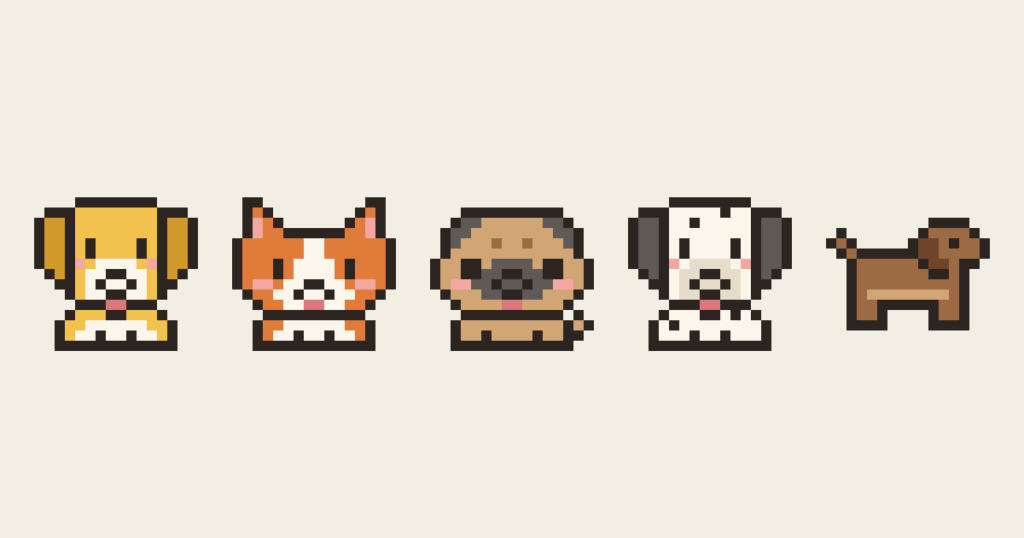
Dogs are a brilliant first subject for pixel art, because there are so many kinds of them. A cat is always more or less a cat, but a dog can be a pug, a corgi or a sausage dog, and each one teaches you a different shape. The good news is that you don’t need hundreds of breeds in your head. You need one simple dog, and a handful of easy changes that turn it into all the others.
All five designs below come from our Dog Sprite Collection, drawn on a 16 × 16 grid with one shared palette. If you’ve never made a tiny sprite before, have a quick read of How to Draw Cute Pixel Art Animals first. It covers the tools, the proportions that make any character cute and a step-by-step method for drawing an animal from scratch. This guide skips all of that and goes straight to what makes a dog a dog.
What makes a sprite look like a dog
At 16 × 16, a cat, a bear and a dog share a lot: a round head, two eyes, a little body underneath. Three things tip the balance towards “dog”.
- A big muzzle. Cats keep their faces small and tidy. Dogs lead with their noses, so the muzzle is a large, lighter patch filling most of the lower face, with a dark nose sitting right on top.
- Ears that tell you the breed. Floppy, pointed or folded, the ears are the quickest way to say which dog you’re drawing.
- A tongue. Not essential, but nothing says “happy dog” faster than two pink pixels under the mouth.
Example 1: The Golden Pup
Our Golden Pup is the dog to learn first. It’s front-facing, symmetrical and uses just six colours, and once you can draw it you can draw most of the other dogs on this page by changing one or two things.

- Start with a box for the head. It’s eight pixels wide inside the outline, with the top corners stepped in by a pixel so it looks soft rather than square.
- Hang the ears outside it. This is the key move for any floppy-eared dog. The ears aren’t drawn on the head; they’re two separate columns, each two pixels wide, hanging down either side from the forehead to the cheeks. That length is what makes them look heavy and soft.
- Make the ears one shade darker. The head is Honey (
#F2C14E) and the ears are Mustard (#D19A2A). That small step down pushes the ears behind the face. Use the same colour for both and they merge into one wide blob. - Give it a proper muzzle. The Cream (
#FBF6EC) patch is six pixels wide and four rows tall, a third of the whole face and about twice the size of a cat’s. The nose is two pixels of Ink (#2B2420) at the top of the patch, and the mouth hangs from it: one pixel stepping out on each side, then two back in underneath. - Keep the eyes simple. Each is a 1 × 2 column of Ink with four pixels between them, just above the muzzle, plus one Blush (
#F2A7A0) pixel on each cheek.
Now compare the first and last panels. The tongue is two pixels of Rose (#D9787A), and instead of sitting inside the mouth it replaces part of the chin line, so it looks like it’s flopping over the edge. Close the line and the same pup suddenly looks calm and a little serious. On a dog, the mouth does a lot of the acting.
Example 2: The Corgi
The corgi uses almost the same face as the Golden Pup, but its ears point up instead of hanging down. That one change, plus some white in the right place, gives you a completely different dog.

- Make the ears too big. Each ear starts in the top corner of the canvas and grows by one pixel every row for four rows, so together they take up a quarter of the sprite’s height. In the grey silhouette, the ears alone tell you it’s a corgi.
- Keep the top of the head flat and low. The head only starts where the ears finish, with one straight line of outline between them. That makes the ears look even bigger.
- Run a white blaze up the middle. The white starts as a two-pixel stripe between the ears, widens to four between the eyes, then spreads across the muzzle and cheeks. This is what stops an orange dog with pointed ears looking like a fox. A fox’s white sweeps up from the cheeks; a corgi’s runs down the middle of the face.
- Keep the jaw wide. The bottom of the head stays wide and square right down to the chin line. Narrow it to a point and you’re back to a fox.
Two fur colours do all of this: Ember (#E07B39) and Cream. Recolour the same pointed-ear head in grey and white with pale blue eyes and you have a husky, which is exactly how the husky in our pack was made.
Example 3: The Pug
So far, every dog has had a big muzzle. The pug is the opposite: a flat-faced breed whose nose barely sticks out at all. It shows how to draw a feature that’s defined by being small.

- Draw a round head with no ears sticking out. The silhouette is almost a circle, widest at eye level where it fills all sixteen pixels. The ears fold over at the top corners, so they stay inside the outline as a few pixels of Charcoal (
#5F5A56). - Turn the muzzle into a mask. Instead of a light patch, the pug has a dark one: a shape of Charcoal around the nose and mouth on the Sand (
#D2A574) fur, spreading out until it nearly touches the eyes. Because it’s flat colour rather than a shape that sticks out, the face looks pushed in. - Make the eyes bigger than usual. A pug’s round eyes are part of its charm, so here each one is a 2 × 2 block, set wide at the edges of the mask. Big eyes and a small nose make the face look squishy.
- Suggest wrinkles with two pixels. Two single pixels of Bark (
#9C6A43) above the eyes look like a worried little frown. No folds of skin needed. - Add the curly tail. A tiny loop of outline with one pixel of fur inside, poking out of the bottom-right corner. It’s only a handful of pixels, but it’s the detail people spot first.
The darkest colour on a face pulls the eye. Here that’s the mask, so the mask becomes the whole personality. The same trick works for a boxer or a bulldog: wide head, dark muzzle, eyes at the edges.
Example 4: The Dalmatian
The Dalmatian is the Golden Pup again in white with grey ears. What it adds is spots, and spots are surprisingly easy to get wrong.

First, a problem you’ll meet with any white dog: there’s no lighter colour left for the muzzle. So go the other way. The Dalmatian’s muzzle is Oat (#E6DCC9), a step darker than the Cream fur, so the patch still shows. Then the spots go on last:
- Use fewer than you think. Ours has just six spot pixels: two on the head and four on the chest. Fill every gap and it looks like a dog covered in crumbs.
- Don’t mirror them. Everything else on a front-facing dog is symmetrical, so it’s tempting to make the spots match too. In the middle panel, the matching pair on the forehead reads as a costume pattern, or worse, a second pair of eyes. Put one spot high on the left and another lower on the right.
- Vary the size. Mix single pixels with the odd pair. The two-pixel spot on the chest makes the single ones around it look smaller and more natural.
- Keep the face clear. A spot beside an eye looks like a wink, and one on the muzzle looks like a second nose. One tucked right under the top outline, as if the pattern carries on over the head, looks far more natural.
These rules work for any patchy coat, from a cow to a ladybird. For more regular markings like tabby stripes, our guide to drawing pixel art cats shows how to place them so they wrap around a shape.
Example 5: The Sausage Dog
Every dog so far has looked straight at you. Some dogs only make sense from the side, though, and the dachshund is the perfect example: its whole joke is its length, which you can’t see from the front.

- Block in two boxes. A long, low box for the body, twelve pixels long and six tall, and a smaller one for the head, overlapping the front of the body and sitting a couple of rows higher. Get the boxes right first; everything else is decoration.
- Point the nose at the edge. In profile, the snout runs forward until it meets the outline on the right, with the jaw stepping back underneath. Plan for this from the start, because a profile dog needs more room in front of its face than you’d expect.
- One eye, one ear. From the side you only see half the face. The eye is a single Ink pixel, and the ear is a little diagonal of Cocoa (
#6E4529) hanging just behind it, darker for the same reason as the Golden Pup’s. - Put short legs at the ends. Each leg is a 2 × 2 stub, one pair at the very front and one at the very back. The empty gap between them is what makes the body look long. A stripe of Sand along the belly rounds off the bottom.
- Draw the tail as a clean diagonal. It rises from the back in steps of exactly one pixel, up and to the left. Even steps keep a diagonal smooth rather than bumpy; there’s more on avoiding these “jaggies” in our beginner’s guide to cute pixel art animals.
Once you’ve got the two-box idea, you can draw almost any dog side-on. Shorten the body and lengthen the legs for a terrier, or stretch the legs right out for a greyhound. The head box decides the breed; the body box decides the pose.
Easy breed swaps
With the Golden Pup and the corgi as your two starting heads, one floppy-eared and one pointy-eared, you can reach plenty of other favourites without starting again:
- Beagle: the Golden Pup in Toffee (
#B38452) with a white stripe down the face, and dark Cocoa ears stretched until they hang almost to the chin. - Chocolate Labrador: the Golden Pup in Bark with Cocoa ears, and a Toffee muzzle instead of Cream so the face stays all one colour.
- Shiba Inu: the corgi with narrower ears, white cheeks that sweep up the sides of the face and a curly tail like the pug’s.
Whatever the breed, stick to one main fur colour, one darker colour for the ears or markings and one light colour for the muzzle. Three fur colours is plenty for a 16 × 16 dog.
Dog-specific mistakes to watch for
- A muzzle that’s too small. If your dog looks like a bear or a cat, this is almost always why. Widen the light patch and make the nose a full two pixels.
- Ears the same colour as the head. Floppy ears need to be a shade darker, or the head becomes one wide shape with no ears at all.
- A giant tongue. Two pixels is perfect. Any more and it looks like the dog is eating something red.
- Drawing fur. Little lines for shaggy fur just look like noise at this size. For a scruffy dog, change the silhouette instead, with a few pixels sticking out at the eyebrows and chin.
Try it yourself
Draw the Golden Pup from Example 1 and save a copy. Then work through these, one at a time:
- Swap the ears: replace the floppy ears with big corgi ears, and notice how much the character changes when nothing else does.
- Swap the muzzle: shrink it into a dark pug mask and make the eyes 2 × 2. Does it still feel like the same dog?
- Draw your own dog: find a photo, decide whether the ears flop or point, and pick the one marking everyone notices first. That’s the detail worth spending pixels on.
When you’re ready for a challenge, turn your dog sideways using the two-box method. The face from your front-facing sprite will tell you exactly which colours to use.
For more animals to practise on, our 20 Cute Pixel Art Animals collection uses the same grid and palette, and our guide to drawing pixel art cats is a great next step if you’d like to see how a similar head turns feline. And if dogs are your favourite, the full Dog Sprite Collection has all twenty of ours, from a sleepy pup on a cushion to a pup bundled up in a woolly hat for a snow day.
1 comment